Why a Food Forest?
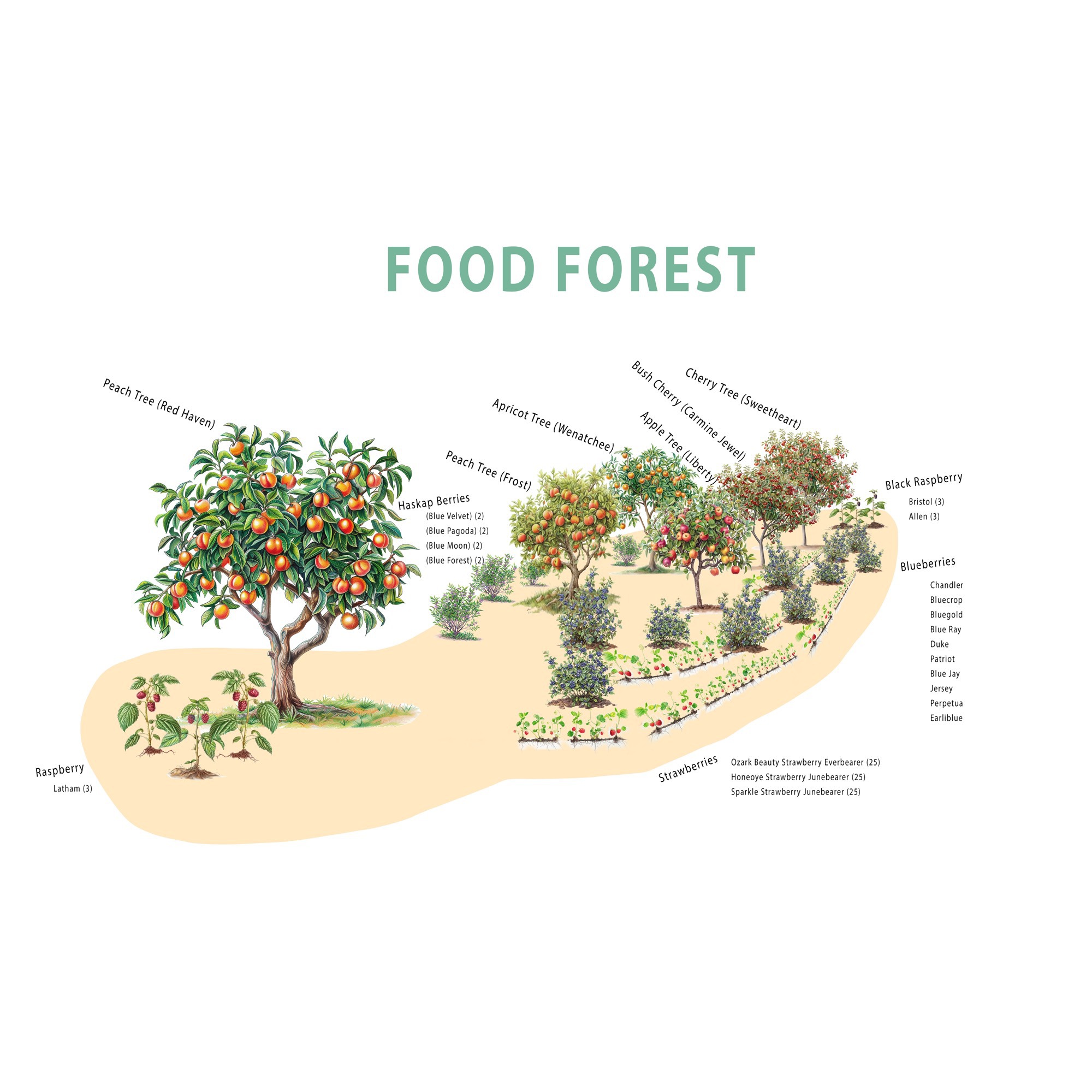
Food forests are unmatched in producing abundance and diversity per square foot — and they need minimal inputs to do it. These living ecosystems create a self-sustaining environment where multiple layers of plants work together, naturally building soil fertility while providing year-round harvests.
What a food forest actually is
Picture a young woodland edge — but every layer feeds you. A food forest arranges plants the way a natural forest does:
- Canopy — full-size fruit and nut trees
- Understory — dwarf fruit trees and large shrubs
- Shrub layer — berries: blueberry, currant, elderberry, aronia
- Herbaceous layer — perennial vegetables, culinary and medicinal herbs
- Ground cover — strawberries, creeping thyme, living mulch
- Vines — grapes, hardy kiwi, passionflower
- Root zone — and below it all, the fungal networks that tie the system together
Each layer occupies a different slice of light, root depth, and season — which is why the total harvest per square foot beats any single-crop planting.
Why it beats conventional gardening
Unlike modern agriculture’s resource-intensive approach, an established food forest thrives with minimal intervention. The system builds its own fertility: leaf litter feeds the soil, deep roots pull up minerals, nitrogen-fixing plants feed their neighbors, and the fungal network moves resources where they’re needed.
That means no annual tilling, dramatically less watering once established, no synthetic inputs — and a landscape that gets more productive every year instead of starting from zero each spring.
Does it work in Connecticut?
Beautifully. Our climate supports an enormous range of productive perennials — apples, pears, plums, peaches, blueberries, currants, elderberries, hardy kiwi, hazelnuts, and dozens of native food and medicine plants that co-evolved with this exact place. The main design constraints in our area are deer pressure and soil condition, which is why every Grow Wild food forest starts with soil testing and a protection strategy — not a plant list.
Where to start
A food forest can begin as one edible border and grow over seasons — or arrive as a designed system covering the whole yard. If you’re curious what your property could support, that’s exactly what a Property Discovery is for.
Ready to explore? Learn about our food forest design services or check your project fit.