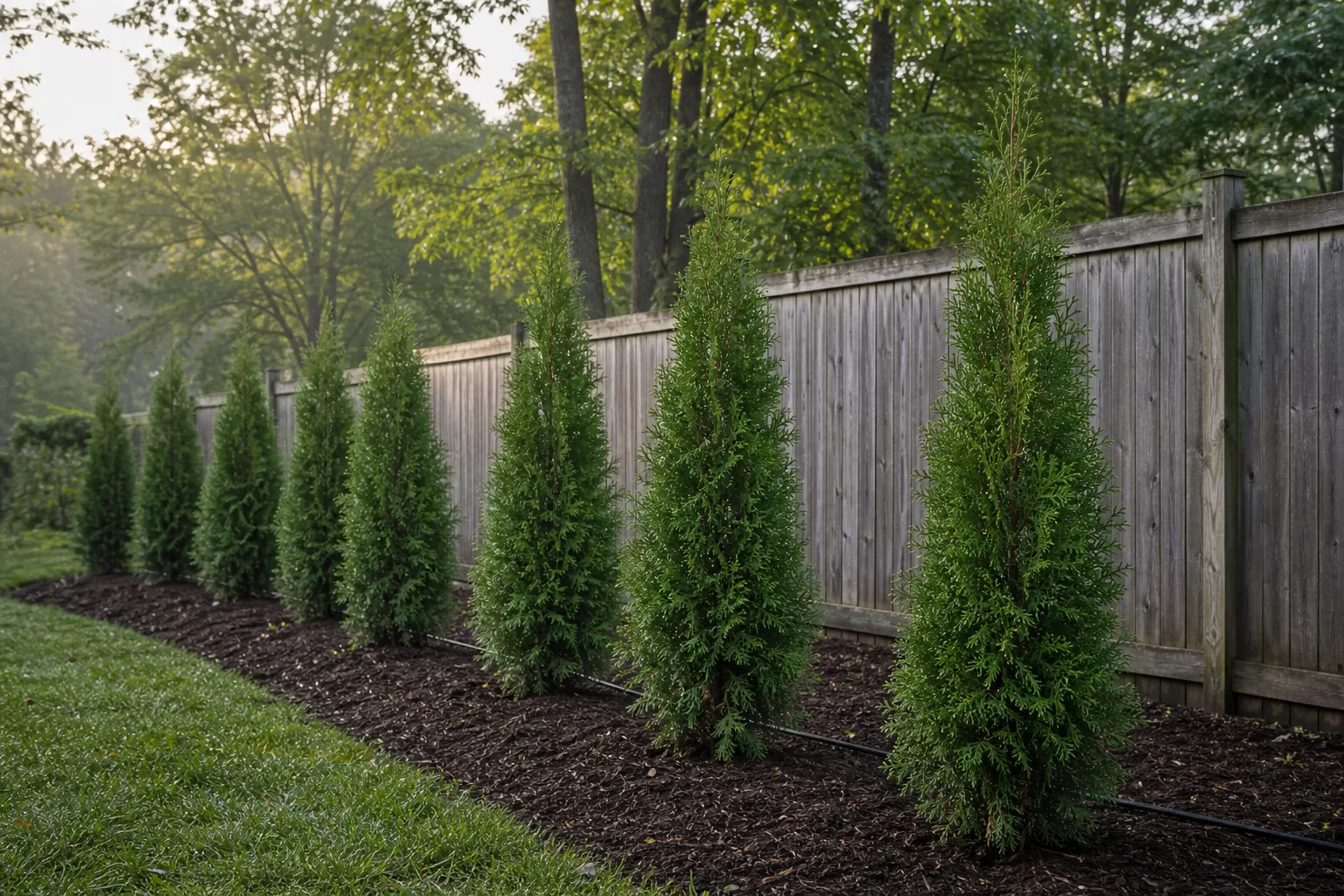
How to Plant an Arborvitae Privacy Screen That Lives
A 23-page Connecticut field guide for planting arborvitae in compacted clay or dry sandy soil, setting the root flare correctly, and establishing a reliable drip-irrigation system.
$30 · Digital PDF
- Site measurement, plant-count, cultivar, and spacing worksheets
- Separate planting methods for compacted clay and dry sandy soil
- Root-flare, container-root, and balled-and-burlapped planting guidance
- Faucet timer, backflow prevention, filter, regulator, mainline, and emitter setup
- First 12 weeks of watering, inspection, and troubleshooting
- Connecticut-focused guidance for deer, drought, winter wind, snow, ice, and salt
No spam — one email when this launches, from Grow Wild only.
Arborvitae are often sold as an easy privacy solution, but the expensive failures usually begin below ground: compacted clay, a buried root flare, circling roots, poor drainage, or watering that never reaches the root ball.
This illustrated field guide organizes the full installation around those failure points. It helps Connecticut homeowners read the site, choose and space plants, prepare either clay or sandy soil, plant at the correct depth, and build a simple drip system that can be measured and adjusted during establishment.
What’s inside
- An 18-inch drainage test and site decision tree
- Clay-soil and sandy-soil root-zone details
- Root-flare identification and planting-day sequence
- Drip-system layout plus emitter-flow and runtime calculations
- A first-season care and symptom-pattern troubleshooting guide
- A raised-bed appendix using stable planting columns with hugelkultur fill
- A reusable field worksheet
This guide is homeowner education, not site-specific engineering, landscape architecture, plumbing-code advice, or a substitute for on-site diagnosis. Utilities, drainage, cultivar, stock format, slope, deer pressure, salt exposure, and irrigation output can change the correct installation.
Want this done-for-you instead?
Everything in the shop comes from our design/build practice. If you'd rather have Grow Wild build it on your property, start with the fit form.